Both platforms are needed
The audience uses both iPhone and Android, and losing half the market at launch is not an option.

A cross-platform framework from Meta that uses native iOS and Android components. We choose it when an app is needed on both platforms without two teams.

Two native teams double the budget and time for every feature. React Native gives you shared code for iOS and Android, so new features ship on both platforms at once.
The audience uses both iPhone and Android, and losing half the market at launch is not an option.
The business wants an app but is not ready to maintain two separate development teams.
The product has a React web version, and part of the logic and approaches can be reused in the app.
Catalog, cart and push notifications about promotions and order statuses.
Business logic shared with the web product and access to core features from a phone.
Geolocation, maps and in-app payments through native modules.
A fast release to the App Store and Google Play to test a hypothesis with real users.

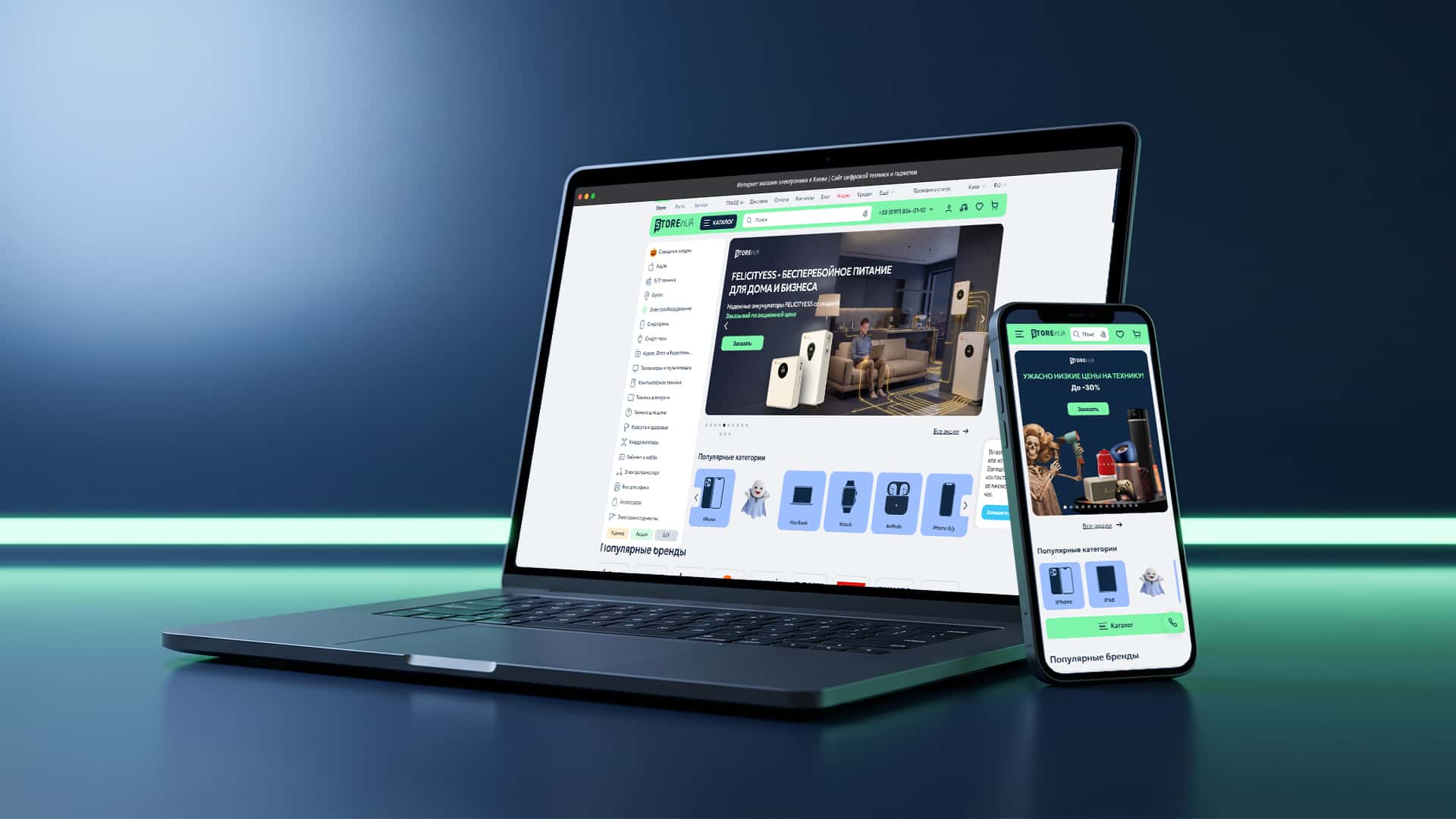 OCTOBER 2026eСommerce / DEVELOPMENT
Purchase conversion up from 1.4% to 3%: a new platform for 1M+ products with no sales stoppage.
Book a Clarity Session—a 30-minute review of your marketing. You will receive a map of bottlenecks and a clear understanding of the next steps.

Clarity first. Then — managed and systematic growth.
The team took a professional approach to upgrading site, ensuring high-quality project delivery without interrupting the store’s operations.
 Nikolay LuchinskyRetail Director / STOREinUA
No, for most business apps. React Native uses native interface components, so users do not feel the difference. For games or heavy graphics work we recommend native development.
It depends on the team and the product, since both frameworks are mature. We choose React Native when there is a web app on React or Next.js: a shared JavaScript language simplifies support and lets us reuse part of the logic.
It depends on features and integrations. An MVP with basic scenarios takes much less time than a full product with payments, a client area and offline mode. Also allow time for App Store and Google Play review.
It depends on the type of change. JavaScript code changes can be delivered over the air, for example with Expo Updates, within store rules. Changes to the native part and new permissions still go through App Store and Google Play review.
React Native app development at GVSPACE means one product for iOS and Android without two separate teams. We build apps for e-commerce, booking and delivery services, mobile versions of SaaS products and MVPs to test hypotheses. We connect payments, push notifications, geolocation and analytics, and a Node.js backend with a React web app keeps the whole product on one stack.